
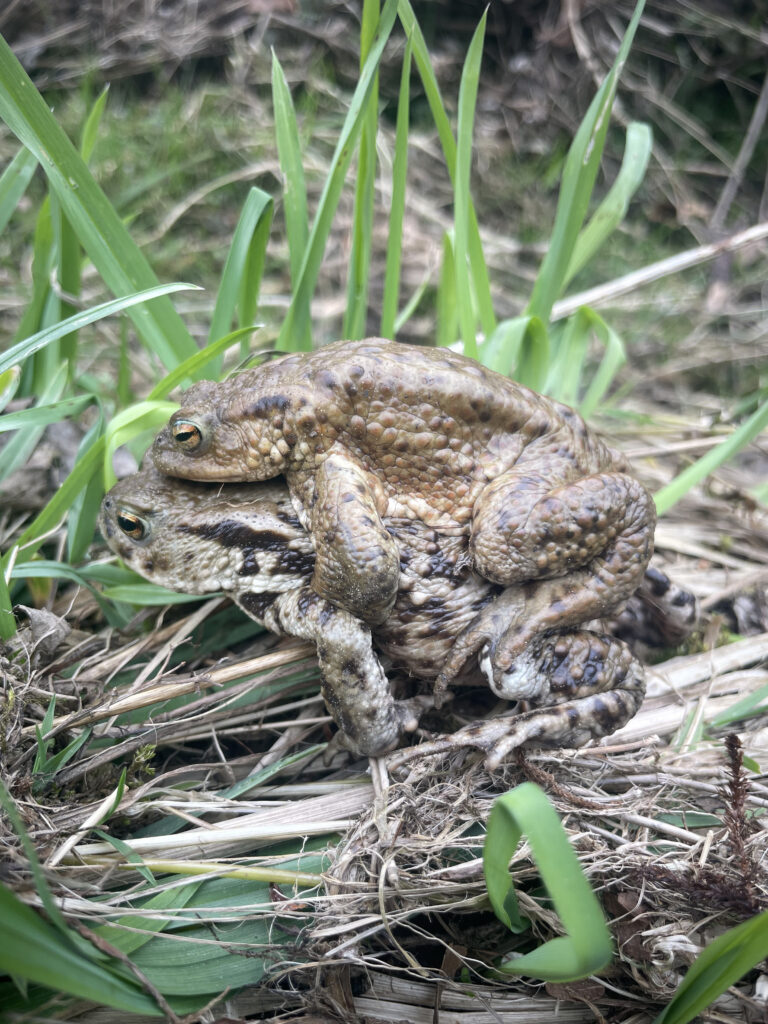
European toads back for breeding season at Heggs Farm
Mission tree guard removal complete!
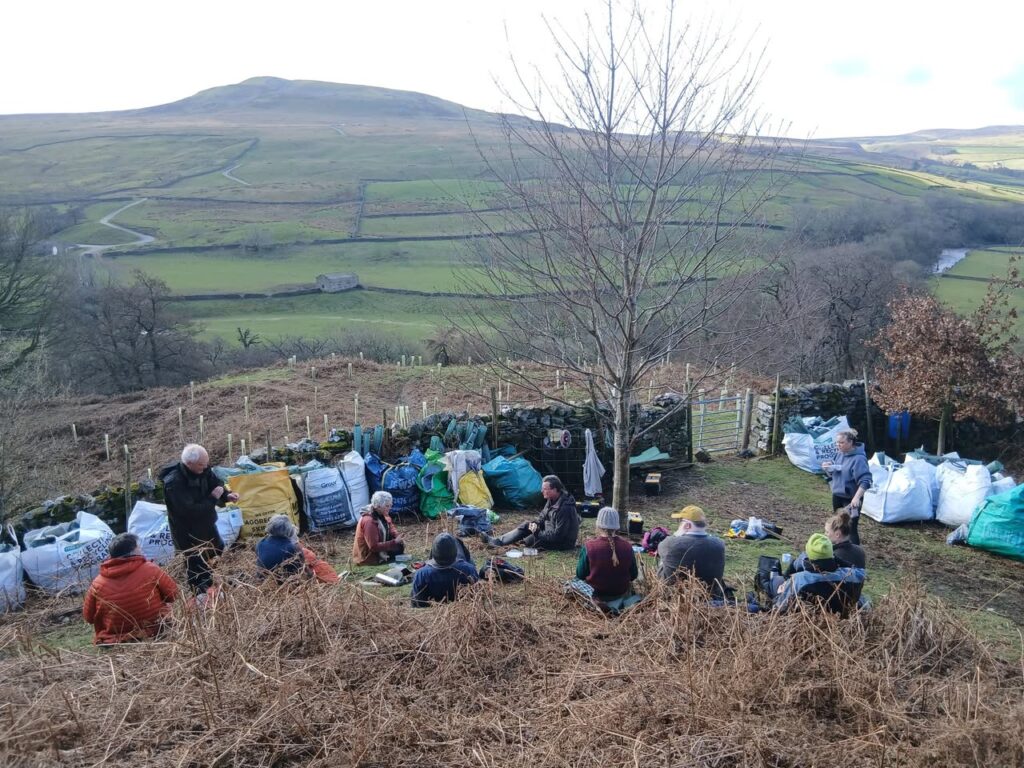
Huge thanks (and well done!) to the 50-plus volunteers involved in removing up to 11,000 tree guards from the 9 acre woodland plantation at Storthwaite, Arkengarthdale. Our final March volunteer day marked the culmination of three winters of challenging but very rewarding work; and there was a collective sigh of relief as we dragged the very last full-to-bursting dumpy bag down the hillside! Special thanks to Margaret for sorting out all of the cable ties we managed to rescue—many of which have already been re-used on our tree planting projects throughout the Two Dales.
Yorkshire Dales Millenium Trust reports Hay Time Project successes
In June and early July 2025, Yorkshire Dales Millenium Trust (YDMT) volunteers undertook botanical surveys of 26 meadows which had previously been restored between 2008 and 2024 as part of the Hay Time Project. More than 70% of the meadows monitored were found to have yellow rattle, red clover, sweet vernal grass and meadow buttercup present—the four functional species considered key in meadow restoration. A great result! Read the full report here.
Sheep and cattle swap boosts biodiversity according to Leeds Uni study
Replacing sheep with cattle at a nature reserve in the Yorkshire Dales has led to a boost in biodiversity, a research project found. Natural England began switching to cattle grazing at its Ingleborough site in the Dales in 2004, with the location now part of the 1500-hectare Wild Ingleborough project. University of Leeds researchers found that in areas where cattle were allowed to roam, plant diversity increased by more than 40% and the number of butterflies increased. The cattle’s positive impact is down to the way in which they move through the landscape, according to Tim Thom, Wild Ingleborough programme manager at Yorkshire Wildlife Trust. “The sheep go along and use their teeth to bite stuff, whereas the cattle wrap their tongues around the grass and pull it out, opening up the sward for flowers.” Read more on the BBC News website.
Right tree, right place: Thoughtful woodland design found to avoid soil carbon losses (Snaizeholme Case Study)
Another Leeds University study has found that England’s new woodland creation guidelines can help to reduce soil organic carbon losses. The research team focused on Snaizeholme, one of the largest upland woodland creation projects of its kind in England, at over 529 hectares, to assess how effectively the guidelines targeted planting to appropriate locations.
While new woodlands can reduce flood risk, improve air quality, support biodiversity, and capture carbon from the atmosphere; these benefits depend heavily on where trees are planted. In upland areas, soils often contain large stores of organic carbon, particularly in peat and other highly organic soils. Disturbing these soils during planting or through changes in hydrology can release carbon that has been stored for centuries, leading to losses that may exceed the carbon taken up by young trees.
By measuring soil organic carbon stocks across planted and unplanted plots at Snaizeholme, the research team found that following England’s new woodland creation guidelines had steered planting away from high-carbon organo-mineral soils, reducing the risk of unintended carbon release to the atmosphere. This is encouraging news: As woodland expansion continues, ensuring that planting happens in the right places, not just the available places, will be essential for balancing carbon goals with biodiversity and land-use priorities. Read the full blog on the Leeds University website.
Planning for the future: England must destine 7% of land to nature and renewables to hit green targets, data shows
England has around 130,000 square kilometres of land, and it faces more demands than ever before. We need to build more homes, generate clean energy and maintain food production, all while restoring nature. And yet without a strategic approach, we risk these competing demands pulling in different directions, when the evidence shows we have enough land to deliver them all.
With this in mind, the Government recently published England’s first Land Use Framework to map how land is used and how it can be adapted to meet changing needs. It shows that about 7% of England’s land—an area roughly two-and-a-half times the size of Cornwall—will need to be given over to nature, forests and renewable energy, to meet the UK’s environmental targets; with enough land leftover to grow the food needed, and to house a growing population. Read more on the Defra blog and further analysis on The Guardian.
Places still available for Richmondshire Landscape Trust site visit
There are still spaces available for a free guided tour around some of the sites in Richmond owned and managed by the Richmondshire Landscape Trust. It will cover Westfields, the only surviving remnant of Richmond’s Medieval open field system; and Nine Acres Field, which has been converted to a wildflower meadow with help from Buglife.
The tour is scheduled to take place on Saturday 18th April, 2-3.30pm and is suitable for families. Please sign up by email to info@sustainableswaledale.org.
Help stop the spread of Himalayan Balsam along the Swale
Join us for a training day learning how to map and remove Himalayan balsam, an invasive non-native species which is spreading along the Swale. Fortunately the amount is reasonably low compared with other rivers (see Map and zoom into the Swale area) but the sooner it is tackled, the less it will spread! Led by Martha McBarron, a volunteer for both the Yorkshire Dales and the Tees River Trusts, the training will be based at Dalton near Richmond where there is plenty of balsam for us to practice on!
Draft programme for the day:
- 10am-12 noon – balsam pulling
- 12-1pm – lunch break at Dalton & Gayles Village Hall with a presentation about Invasive Non-native Species (INNS)
- 1-3pm – optional training and practice using the INNS mapper (an app for recording presence and management) AND/OR further balsam pulling
A choice of dates in July has been offered: Sunday 5th July, Monday 6th July or Tuesday 7th July. If interested, please enter your name against the dates you can do on our Volunteer Google Sheet and we will choose the most popular one. Alternatively, please email your details to info@sustainableswaledale.org.
DalesBus back in action from Easter Sunday
The popular Summer Sunday and Bank Holiday DalesBus timetable will start again on Easter Sunday, including these buses in Swaledale:
- Northern DalesBus 830: Ribblehead – Hawes – Reeth – Richmond (does not run on Bank Holidays)
- Northern DalesBus 831: Middlesbrough – Darlington – Richmond – Reeth – Hawes (with onward connections to Ribblehead, Sedbergh and Kirkby Lonsdale).
More good news is that North Yorkshire Council has advised that elderly and disabled bus passes will be valid for free travel on these buses this year. Otherwise the maximum single fare is £3 (£1 for under 19s).
Find the timetable online here, or pick up a printed leaflet from Hudson House.
World Curlew Day Art & Poetry Competitions
The 21 April 2026 marks the tenth World Curlew Day and conservation group Curlew Action is marking the anniversary with two ‘celebratory’ themed competitions for art and poetry—including categories for Primary School, High School, and Adult.
Prizes for the Adult and High School category will be a pair of Curlew socks of a new design, and a new Curlew colouring book for the Primary School age category entrants. Your design will also be featured on Curlew Action’s social media, website, and possibly in other places in the future.
The deadline for entries is midnight of 10 April 2026, and winners will be revealed on World Curlew Day. Please confirm which category you are entering when you send your entry to flo@curlewaction.org.
Ousewem 2026: upstream and downstream resilience
2026 is Ousewem’s biggest year yet for natural flood management (NFM) across the Swale catchment and beyond. From working with farmers and landowners to modelling future scenarios, this year’s work strengthens resilience for upstream and downstream communities in a changing climate beyond 2027. Read more about what the team have in store here.
Request for website gallery photos
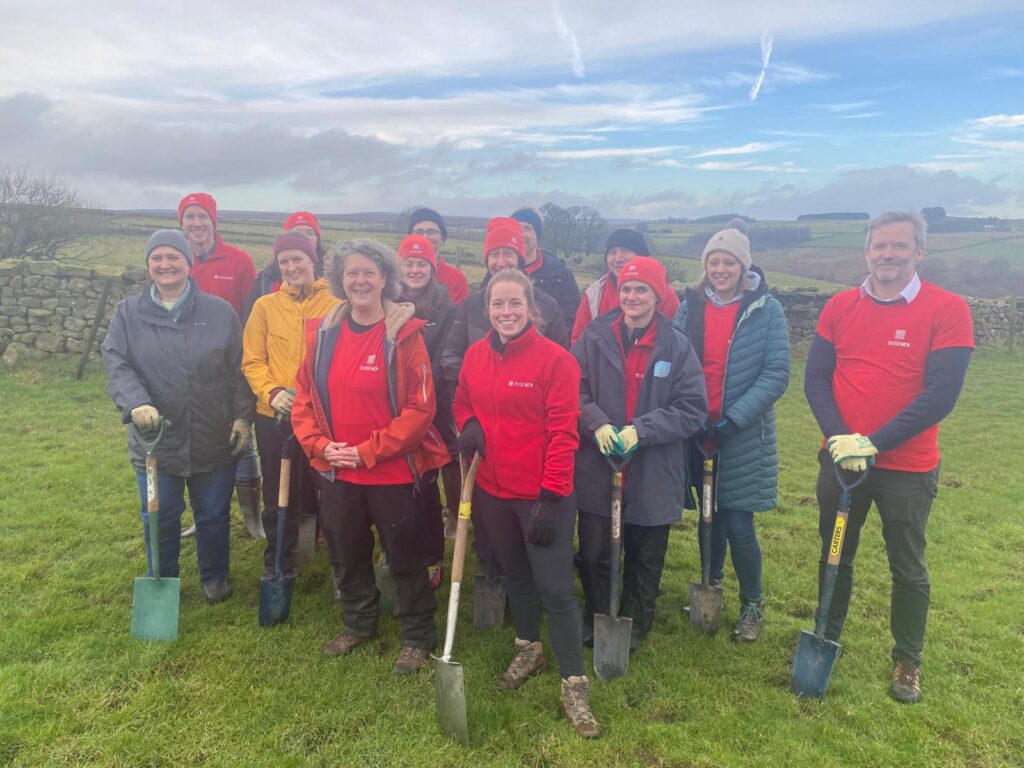
We’ve been busy behind the scenes bringing www.sustaintableswaledale.org up to date, including removing redundant pages and adding new info about our ongoing projects. As part of the revamp we’d like to add a gallery to showcase our volunteer activities. If you have any photos of Sustainable Swaledale work days and events that you’ve attended, and you’re happy to share them, please upload them to our shared Google Drive folder, and label them using the following naming convention: YYYYMMDD-Location or activity-Your Name (if you wish to be credited).
Shout out for Evan Davis's heat pump challenge
In light of the recent government announcement re funding for heat pumps, there’s been some discussion in our Facebook group about their efficacy. If you’re considering whether a heat pump might be suitable for your home or you’re just interested in learning more about them, this BBC Sounds podcast is a great listen.
And lastly: Our Yorkshire Peat Partnership visit to Nethergill Farm, by Margaret
A group of us enjoyed a visit to the peatland around Nethergill Farm in Ougthershaw on a glorious spring day earlier this month. Part of a series of six workshops with different community groups, the aim of the day was to give us both the opportunity of a guided walk around some peatland undergoing restoration and an introduction to green drawing.
Our thanks go to Lucy Lee and Millie German of the Yorkshire Peat Partnership (YPP) and Yorkshire Wildlife Trust (YWT) respectively and Ali Foxton, our green drawing instructor for making it such an instructive day.
We found out about how the peatland was being restored with grips being filled in (stone dams used where the peat had completely degraded) and how YPP are monitoring the success of their interventions through longitudinal surveys of vegetative survey plots and pipes set into the ground allowing well dipping- a measure of how much water the restored moss is retaining. Peat poles inserted into the ground showed us varying depths of peat up to 2 metres and more. We found four of the roughly eighty sphagnum mosses commonly found in the UK alongside bilberry, cranberry, hare tail and other grasses and rush and saw some wonderful matchstick lichen. We heard curlews, were serenaded by a skylark over lunch and saw evidence of both owls and mice and voles via owl pellets. Deer were spotted in the distance and a spider at our feet. The YPP’s goal of rewet, replant and restore was very much in evidence.
We learnt that despite fears regarding our artistic skills, that everyone could do a sketch of something found within the environment and that whatever the artistic outcome, we had all benefitted from taking the time to look at something in detail enough to draw it. That sense of unwinding, relaxing and reconnecting with nature is part of the philosophy behind green drawing. We learnt that one can do a quick sketch in 10 seconds and that only two minutes was enough to produce something meaningful so no excuse for not being able to find the time. We learnt how to break down a landscape so that even five lines would be enough to give a representation and that spending even a short time “air drawing” allowed us to start picking out individual details within the landscape such as a gully with waterfall, the patterns made by the walls, tracks across the landscape and shadows from the clouds. I am no artist but was pleasantly pleased and quite proud of my artwork!
We all produced a final art work, from which a selection will go into an art wall at Nethergill Farm and be on display over the summer. Some of the artwork is already up – see picture below.
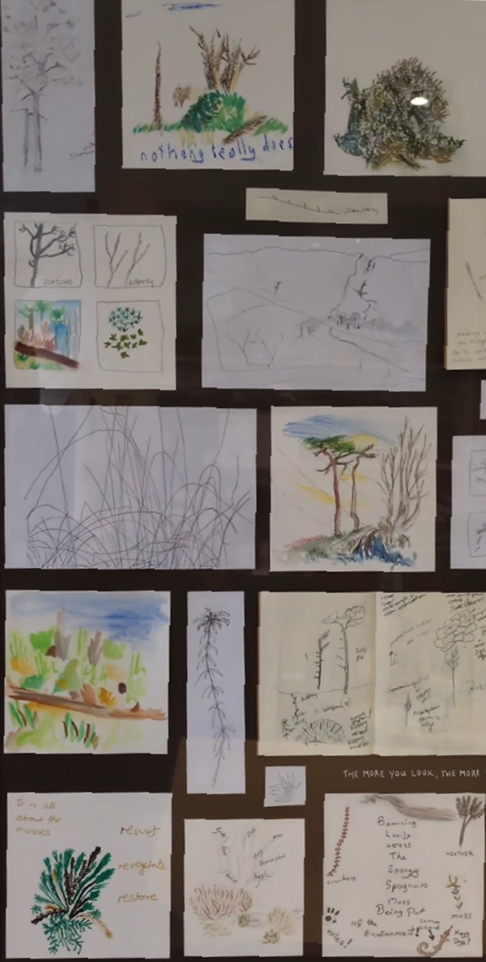
You can watch a video of the exhibition being set up at the Nethergill Farm Nature Barn here (exhibition opening dates will be confirmed once we know them).
The YPP are always keen to engage with volunteers and we will see how Sustainable Swaledale can work with them in the future. It would be great to see and help with some projects closer to Swaledale but that is dependent on landowner engagement with the YPP.
Group Meeting
The next group meeting is on Thursday 2nd April, 7pm at The Vicarage in Reeth (end of Langhorne Drive). The theme will be nature restoration, plus anything else you’d like to discuss!