
Grinton
Bats seeking sanctuary in England’s churches
New research, based on citizen science surveys by the Bat Conservation Trust, estimates that half of England’s 8,000-plus churches have bats in them. And that figure rises to about 80% for older churches.
“They’re basically like a man-made forest,” says a trust representative. “Full of little nooks and crannies where they can roost, big open flight spaces, dry spaces inside, away from the rain, where they can fly around. It is really just an absolutely perfect environment.” Read more on BBC News.
Curious to learn more about these nocturnal creatures first-hand? Bat walks will resume at our local St. Andrew’s, Grinton in the spring. Details to follow in the new year.
The Youngwilders: On a mission to accelerate nature recovery by inspiring the next generation
Youngwilders was founded by a group of friends determined to accelerate nature recovery, and to connect young people (18-30-year-olds) with a natural world they are often excluded from.
Four years after taking over the management of their first site—a former 30-acre retirement home for horses in Surrey—the group is already seeing results. Nature is returning in droves; from nightingales and grass snakes, to slowworms, bats and insects.
The organisation is now building momentum across the north of England, including taking management of sites at Hepple Estate in Northumberland and Castle Howard in North Yorkshire. Read more on The Guardian.
Introducing The Northern Eco: A new weekly newsletter by Leyburn ex-Guardian journalist, Sarah Hartley
Introducing The Northern Eco, a new weekly newsletter produced by ex-Guardian journalist Sarah Hartley, who lives in Leyburn. The Northern Eco covers environmental topics across the north of England but with a special focus on Sarah’s home patch.
Sarah got in touch recently as she wanted to highlight some of what Sustainable Swaledale is up to: You can read her coverage of our winter activities, plus a round-up of local environmental news—including the latest on Hope Moor Wind Farm, Northumberland flood plain restoration, and some great local bookstore recommendations—in the latest newsletter. (It’s free to subscribe to the public version, or you can choose to support via a monthly donation).
Free webinar: What is Rewilding, hosted by the Yorkshire Rewilding Network Tuesday, 16th December 2025, 19.30 - 20.30, online via Zoom
Rewilding is about principles and guidelines instead of rules and procedures–which for many is part of its appeal! In this free webinar, Sara King, Rewilding Manager at Rewilding Britain, will outline how Rewilding Britain sees rewilding at a national level. Jeff Davitt, Yorkshire Rewilding Network Trustee, will then cover YRN’s approach (which also includes small scale, urban and garden settings). Register for free here
Oxford Real Farming Conference (ORFC) tickets now live 8-9 January 2026
From practical, farm-applicable knowledge sharing to the latest in food-systems policy and rights of nature, building caring and resilient farming communities, and global landworker solidarity, the ORFC 2026 programme has something for everyone. More than 40 sessions will be livestreamed, featuring discussions on the rights of nature, regenerative ag, and resilient food systems. You can view the full programme and buy tickets here.
Hedge laying along the Swale Trail
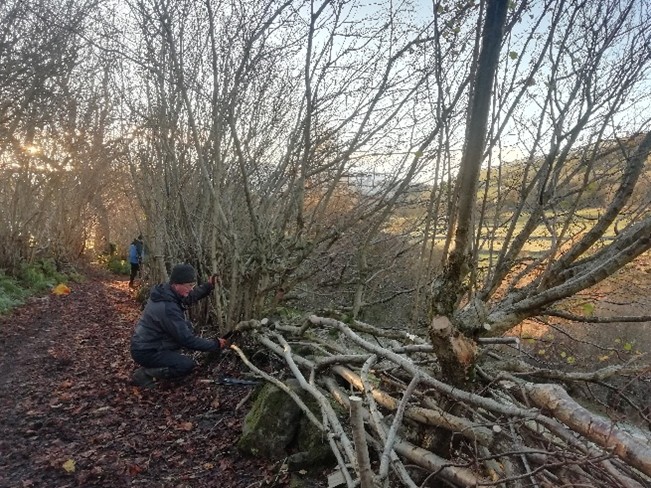
November has seen three Sustainable Swaledale sessions of hedge laying along the Swale Trail, all organised and led by Peter Butler. We have welcomed a few new hedge layers as well as some seasoned volunteers and everyone agrees that hedge laying is a very satisfying activity (a sentiment nicely captured in a poem by Harriet Fraser: What you might learn when laying a hedge).
Under Peter’s guidance, we have made a good start on a new section further along the trail. As we walk to the site, we also pass the hedges that were laid two years and one year ago; both are looking nice and healthy and growing new shoots!
We plan to do another three or four midweek and weekend sessions after Christmas. Please keep an eye on our Facebook group for further details. In the meantime, you can enjoy some timeless inspiration in this 1940’s Ministry of Agriculture video: Hedging 1942.
Willow planting at Swallowholm, Arkengarthdale
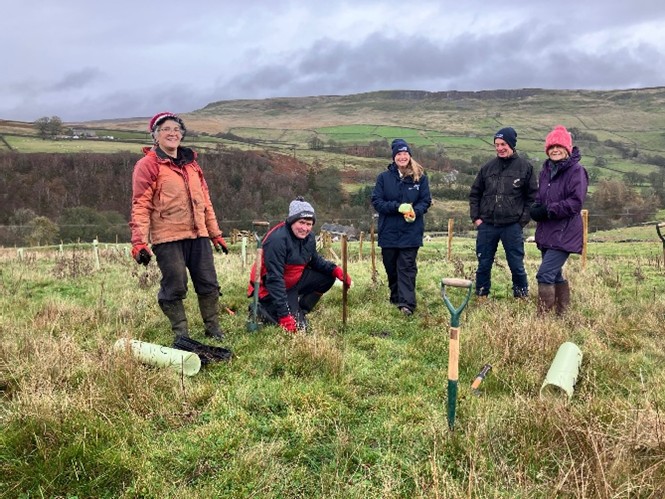
A group of volunteers returned to Swallowholm this month—a site where we completed a number of tree planting sessions last winter—to add a selection of rowan, tea leaved and dark leaved willows to the planting mix. The willows are rarer upland species that were either propagated from cuttings at our willows workshop in 2024, or more recently collected from Ravenseat.
We were joined by John (landowner), Sarah from the Yorkshire Dales Millennium Trust, and Rosie Page (“James Herriot’s daughter”) who is a sponsor of the YDMT Seed to Sapling Project—which has helped fund and support our tree nursery project.
The two Peters along with John have also been busy laying the large overgrown hawthorn hedge—a mammoth task!—and using some of the brash to make a dead hedge down along the river bank.
Wildflower plug planting near Isles Bridge
The start of the month saw a number of volunteers helping to enhance a meadow by adding plug plants—an ongoing project run by Sustainable Swaledale for the Yorkshire Dales Millennium Trust. Species such as autumn hawkbit, birds foot trefoil, meadow cranesbill, red clover, ribwort plantain, self-heal and yarrow were added to the field to extend the existing floral mix and enhance the biodiversity. Volunteers were supplemented by local residents, including children who had great fun as ‘runners’ and extracting the plug plants with lolly pop sticks!
Want to get involved with future winter volunteer activities?
There are still places available for our winter volunteer activities in December and January (with more dates to be added soon). From tree planting to hedge laying; from Maske to Muker; all helping hands are most welcome! Check dates and sign up via our online spreadsheet.
News from OUSEWEM: Digging deeper into soil health and flood resilience
Healthy soils quietly protect our farms and communities. They hold water, grow stronger crops, and can help reduce flood risk. This autumn, Ousewem has been exploring how better soil management can build resilience across our catchments – from Masham to Swaledale.
At a recent event near Masham, farmers watched demonstrations of aeration and subsoiling in action, sparking discussion about which approaches work best for different land. Compacted soils stop rain from soaking in, leading to waterlogging and runoff. Restoring soil structure helps water move freely again, improving yields and reducing flooding downstream.
Rachel Flood, Ousewem Project Manager, said:
“By partnering with others and learning from what’s already happening, we can identify where Ousewem can add value and help build further resilience.”
Ousewem’s pilot is testing how soil health fits alongside tree planting, ponds, and other natural flood management measures. The learning will help shape support for farmers across our focus areas – including Arkengarthdale, Bellerby, and Bishop Monkton.
If you’re interested in improving your land’s soil health interested in flood resilience projects or think your land could benefit from fully funded NFM measures, please contact us.
- Visit: www.ousewem.co.uk
- Email: ousewemdelivery@ydrt.co.uk
Group Meeting
The next meeting will be at the Reeth Memorial Hall (supper room) at 7pm on Thursday 4th December. We will be joined by Jon Lovett who has offered to lead a session on nature and the economy based on his work with Natural England and various projects worldwide.