
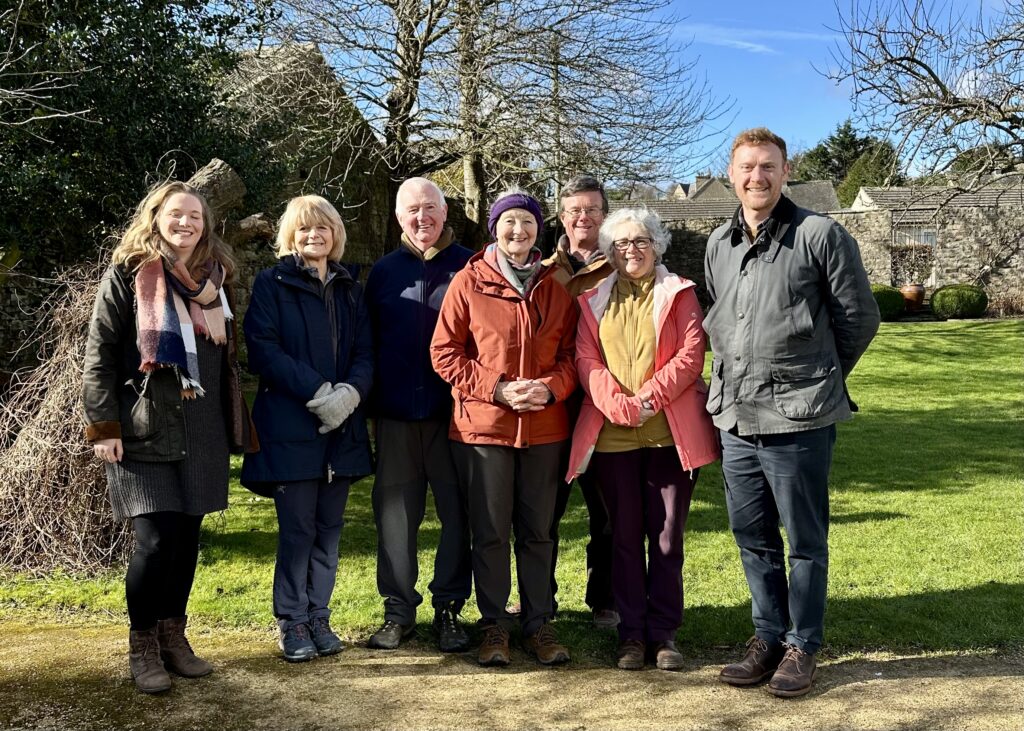
Yorkshire Dales Millennium Trust staff and Rosie Page along with Reeth Community Orchard and Sustainable Swaledale volunteers.
Free talk and bird walk @ Reeth Memorial Hall: Building Homes for Dales House Birds project
Yorkshire Dales Millennium Trust (YDMT) has secured a grant from the Heritage Lottery fund to help save four iconic bird species through a three year ‘Building Homes for Dales House Birds’ project. To kick-off the project, it will be hosting two free events at Reeth Memorial Hall this month:.
Thursday 3rd April, 7pm: Join YDMT and the Yorkshire Dales Park Authority staff for a free talk, detailing how the project will help local groups to create suitable nest sites and habitats for starlings, swifts, house martins and house sparrows (all now on the UK Red List). No booking needed.
Saturday 26th April, 10-12.30: Join Chris from the RSPB for a free ‘Walk, Talk and Watch’ event, featuring a guided bird ID walk through Reeth.
Register your interest via this link: https://forms.office.com/e/gG1vhA3uAi
Bird box building day @ Low Row Institute
Separately, Sustainable Swaledale will be hosting a bird box building event at Low Row Institute on 16th April as part of its WingIt project supporting swifts, swallows and martins. Come and help make a bird box to take away at this hands-on workshop from 2-5pm. Open to all, including children (when accompanied by an adult). Refreshments available to purchase on the day.
Please register your interest in advance by emailing info@sustainableswaledale.org
Defra’s Land Use consultation now open
Open to all now until the end of April, Defra’s Consultation on Land Use is the first step towards the publication of the government’s long-awaited Land Use Framework for England—providing stakeholders with the tools they need to optimise land use for multiple benefits. With limited land available and increasing pressure on it—from house building and food production, to legally binding nature and climate targets—the framework aims to support better, more sustainable, more joined-up decision making across both national and local levels.
This seems crucial: The Royal Society estimates that the UK would need additional land twice the size of Wales to meet all the targets set by governments over the last few years. There’s also an urgent need for better-informed land use, learning from past mistakes: Think conifer plantations on deep peat, solar panels on prime agricultural land, or building car-reliant housing estates on greenfield sites, devoid of infrastructure. Find out more on the Food, Farming & Countryside Commission website.
Have you logged your latest curlew cry?
We are extremely lucky to have breeding curlews in Swaledale and Arkengarthdale. Curlews joined the IUCN Red List of threatened species in 2008 as a result of declining numbers. The RSPB website indicates that there are now only 68,000 breeding pairs in the UK, comprising between 19% and 27% of the global breeding population, and that according to the latest British Trust for Ornithology (BTO) Breeding Bird Atlas (2011) their breeding range has declined by 17% in mainland Britain. The Northern Upland Chain Local Nature Partnership invites everyone to log their curlew records, which are then added to a responsive map, allowing you to see their spread across Northern England over time.
New tree nursery creches installed @ St Mary’s Arkengarthdale
On the 14th March, two tree nursery creches were established at St Mary’s Arkengarthdale, as part of an Arkengarthdale Hub initiative. Built using pallet collars, these enclosures protect the saplings that are being grown from local seed and cuttings—all collected from across the two dales by Sustainable Swaledale volunteers, with landowner permission. They join the four tree creches already established behind Reeth Medical Centre as part of the Yorkshire Dales Millennium Trust (YDMT) ‘Seed to Sapling’ project.
One of the supporters of this project is Rosie Page, daughter of Alf Wight (James Herriott), who visited Reeth recently to see the project in action. After a tour of the creches, Rosie went to Reeth Community Orchard Garden, where she was shown the very first hazel trees to be planted out from hazelnuts collected at Ivelet Wood. Read more on the YDMT blog.
‘Our Power, Our Planet’ announced as the theme for Earth Day 2025
Now in its 54th year, Earth Day is an annual event on 22nd April, bringing together more than 1 billion people across 193 countries to demonstrate their support for environmental protection. This year’s theme is ‘Our Power, Our Planet,’ inviting people around the globe to unite behind a shared target to triple the global generation of clean electricity by 2030. Find out more on the Earth Day website.
Solar farms managed for nature can boost bird numbers and biodiversity
Research recently published by Cambridge University and the RSPB shows that solar farms can deliver on clean energy and increase wildlife, when planned and managed in favour of nature. The study found that solar farms in the East Anglian fens contained up to three times as many bird species as surrounding arable farmland, with those containing the greatest mix of habitats having the highest abundance of birds in total. Read more on the RSPB blog.
State of Nature looks promising at Lowther Estate, Penrith
The Lowther Estate (near Penrith) has been rewilding 3,000 hectares since 2019—one of the largest conservation initiatives of its kind in England. It has just released its first State of Nature report, summarising the changes large and small, observed over the last 5 years. The findings include a 341% increase in breeding bird territories, and an increase in jobs and volunteer hours, with 12 people now employed directly in nature restoration. It also shows an increase in lapwing habitat following the introduction of water buffalo and beavers. Find out more, including how to visit, on the Lowther Estate website.
Wild beaver release approved for England
Following several years of trials, the government has approved the reintroduction of beavers to England’s waterways under a licensing system overseen by Natural England. Hunted to extinction more than 400 years ago, these “ecosystem engineers” have slowly been making a comeback, with up to 500 beavers already believed to be living wild in England. While they are credited with slowing the flow, and creating habitats where other creatures can thrive, long term plans will also need to be in place to avoid impacts on farming, food production and infrastructure. The NFU agrees this planning is vital, and should include the option of relocation and/or culling where beavers prove disruptive or their numbers get out of hand. This is already the approach taken in Scotland, which is several years ahead of England and has more than 1,500 beavers living wild. Read more on the BBC website.
Building flood resilience in Swaledale—a thank you from OUSEWEM
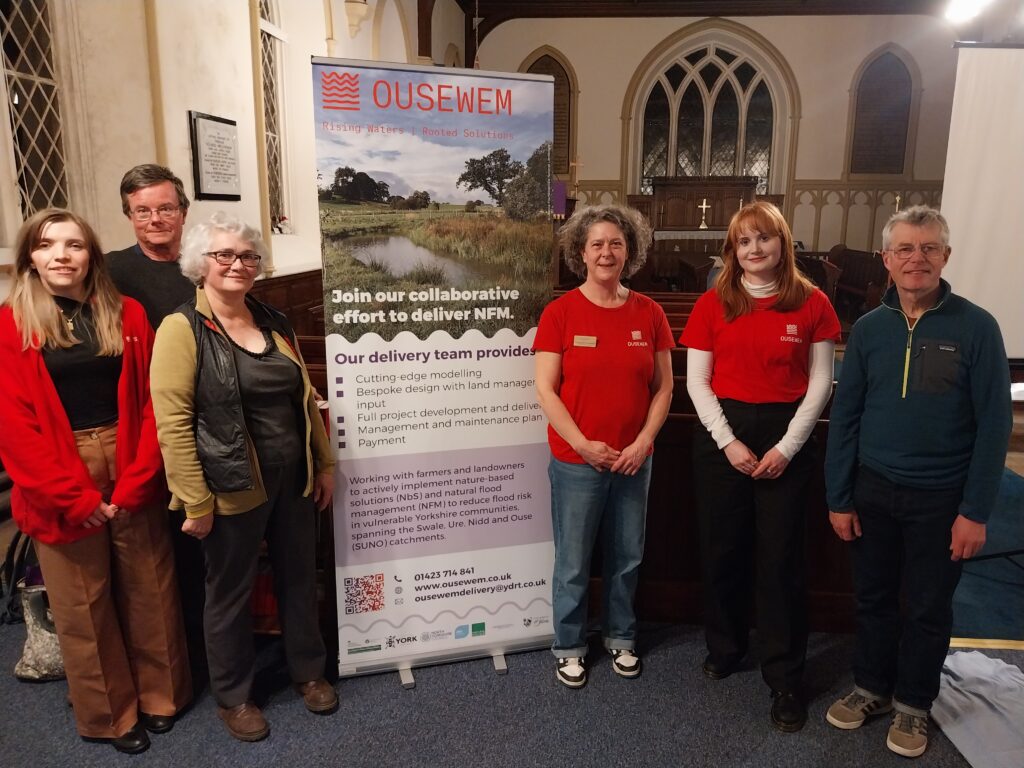
Thank you to everyone who joined us at the Sustainable Swaledale March meeting and to Sustainable Swaledale for the opportunity to share Ousewem’s work. It was great to discuss how nature-based solutions (NbS)—such as leaky dams, scrapes, and tree planting—can help manage flood risk while enhancing local habitats.
Ousewem’s flood modelling efforts are shaping the delivery of natural flood management (NFM) across the region, and the meeting sparked valuable discussions on how data-driven insights and local knowledge can work together to build long-term resilience.
Ousewem is also working closely with farmers and landowners to develop fully funded, bespoke NFM projects that align with their land’s needs. On 10 March, we held a Pie and Peas Night in Reeth, bringing together farmers, conservation experts, and Yorkshire Dales National Park Authority (YDNPA) advisers to discuss funding opportunities and practical ways to integrate NFM into farm management.
If you’re interested in flood resilience projects or think your land could benefit from fully funded NFM measures, visit www.ousewem.co.uk or email us at ousewem@york.gov.uk.
Sustainable Swaledale Membership Renewals 2025
There is still time to renew your membership or consider taking out membership for the year. While we have been lucky enough to be awarded several grants for our tree planting, WingIt, tree nursery and magic meadow projects, the group has a number of additional costs that it has to cover from its membership income, such as insurance, web hosting, supporting the Reeth Surgery Community and occasional room hire. Membership income also allows us to support new projects.
The Membership fee is £10 (£5 concessions) for the calendar year. If you would like to support our activities as a member, you can pay in the following ways:
Bank transfer: email info@sustainableswaledale.org for bank details
Cheque: Cheques made payable to Sustainable Swaledale can be sent to the Treasurer; Rob Macdonald, Mudd House, Low Row, Richmond N. Yorkshire DL11 6NN
Cash: Cash can be paid to the Treasurer at the monthly meeting.
A big thank you to those who have continued to support Sustainable Swaledale by already renewing their membership.
Group Meeting
The next meeting is at 7pm on Thursday 3rd April at Reeth Memorial Hall, where YDMT will be giving its talk on the Building Homes for Dales House Birds’ project.